
Özge Savaş
Geopolitical and historical context
Türkiye is often described as a country that straddles continents, histories, and identities.
While never formally colonized by a European power, it still felt the intense influence of Western imperialism after the fall of the Ottoman Empire in the early 20th century. As the new Turkish Republic tried to “modernize,” it looked to the west for guidance—importing European ideas, values, and political models. Many of these changes brought about deep political, cultural, and social shifts. Some scholars argue this wasn’t just modernization, but a kind of internal colonization that erased local cultures, silenced minority communities—especially ethnic minorities, non-Muslim groups, and women—and privileged Euro-western ways of thinking.
Women played a dual role in this new national identity. On the one hand, they were celebrated as symbols of progress, modernity, and the future of the nation. But on the other, they were systematically denied real political power and meaningful inclusion in decision-making. Feminism was sidelined.

Insights from Interview
Following the military coup in 1980, feminist organizing re-emerged beyond the boundaries of formal political institutions, with particular attention given to the enduring structural inequalities faced by women—violence against women, legal rights, and social exclusion.
In the 1980s, Türkiye implemented a range of austerity policies that included the widespread privatization of publicly-initiated institutions, limiting the state’s role in economic and social services. Psychology, as a discipline, was deeply impacted by this shift. Emphasizing measurable outcomes, efficiency, and professionalization, Psychology in Türkiye began to mirror the very Western models it once critically engaged with. The discipline narrowed, sidelining critical perspectives and embracing individualistic, depoliticized accounts of human behaviour.
Özge Savaş was born and raised in Türkiye before coming to the United States to pursue doctoral work at the University of Michigan. Growing up, she experienced first-hand the patriarchal dynamics that had led to a lack of opportunity for her own mother. It was this intimate knowledge, this lived experience of inequality, that sparked her interest in gender and justice.
Early in Savaş's education, she developed a critical perspective on the theories and methods imported to Türkiye from the west. The individualist tendencies of western paradigms, particularly within clinical Psychology, were not reflective of Savaş's own life experiences.

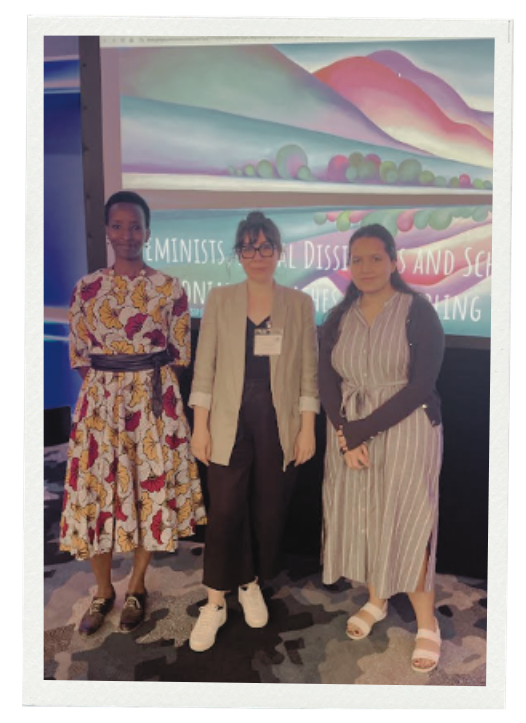
Özge Savaş: “I started with categories, interviewing both women and men Syrian refugees. And then somehow arrived at this understanding of, when you deploy intersectional feminist and decolonial thinking and have an eye towards the institutional and systemic… you start seeing it as not just ‘women’ and ‘men’ but seeing it as female-headed households and male-headed households. And male-headed households have women in them who have different experiences than women who are in the female-headed households…. But then also my work with interpreters and translators in the field. Because of my language and cultural barrier working in the resettlement context it also has been interesting to think from a decolonial lens and sort of like how you establish trust in the field when you do this work, how you build relationships with the interpreter, but also have your interpreter build relationships with people, and your participants and the people in the community become your family as you do this work. So that is also, you know, an aspect of decolonial thinking that comes to play a role.”
Özge Savaş: “For me, the biggest connection between feminist work and decolonial work – and I did this thing that even like gesturally like put them on these two separate buckets – well how they come together and where they come together is thinking about relationality. One of the things I think feminist psychologists, psychology work in the past sort of has done an overcorrection, like ended up getting us to this place where we are still stuck in the binaries. And our analysis, our gender analysis can’t be relational, and I think that is what the decolonial feminist thinking brings: relationality.”
Özge Savaş: “I go back to thinking that feminist and decolonial work provides a lens or a way of thinking, a way of looking at the power dynamics which are very essential to how we see ourselves, how we interact with others, and how we feel we belong, or not belong, or are excluded. So that is how I I see the connection.”
Credits
All images courtesy of interviewees.